

Introduction to Floodlight Maintenance in Sports Infrastructure
Contemporary sports lighting relies on systems that provide an uninterrupted service. Sports stadium lighting is far more than just illumination; it is an asset for the smooth functioning of games, the safety and visibility of the participants, and broadcasting. Such a system not only impacts game play, spectator comfort and enjoyment, but also broadcasting. These unaffected processes remain by externalities, regardless of the environment.
Without proper maintenance and care, even the most innovative systems start to lose their strength and become weak and get damaged, often going unnoticed initially. Fluctuations in brightness and heat start off small, before developing into reduced efficiency, rising costs, and malfunctions at crucial moments, especially during live sports events and broadcasts, when reliability is paramount.
Environmental factors only add to the problem of damaging light. Dust buildup on the stands, moisture exposure, and fluctuating temperatures are some of the factors that affect sports lighting efficiency, and output of the power will be more.
Key priorities include:
- Ensuring consistent illumination performance
- Minimizing unexpected system failures
- Reducing long-term operational costs
- Maintaining compliance with safety standards
- Supporting uninterrupted sports and event schedules
2. Understanding System Components and Failure Points
Every lighting system is composed of multiple interconnected elements. Luminaires, drivers, wiring assemblies, mounting structures. Each plays a role. Each has a vulnerability. Failures rarely happen without sign of the warring appers. They begin as minor inefficiencies on the lights. Slight flickering. Reduced brightness. Irregular performance on the lights. These are early indicators to understand.
Electrical components are particularly sensitive in the cables we have to be careful. Voltage fluctuations can accelerate wear. Over time, insulation degrades. Connections loosen. Heat builds up. Mechanical structures also face stress. Wind loads and heavy loads on the stand bar. Vibration and environmental exposure. These factors gradually weaken structural integrity. Understanding these failure points allows for targeted maintenance. Not guesswork Precision. That makes the difference.
3. Routine Inspection Protocols
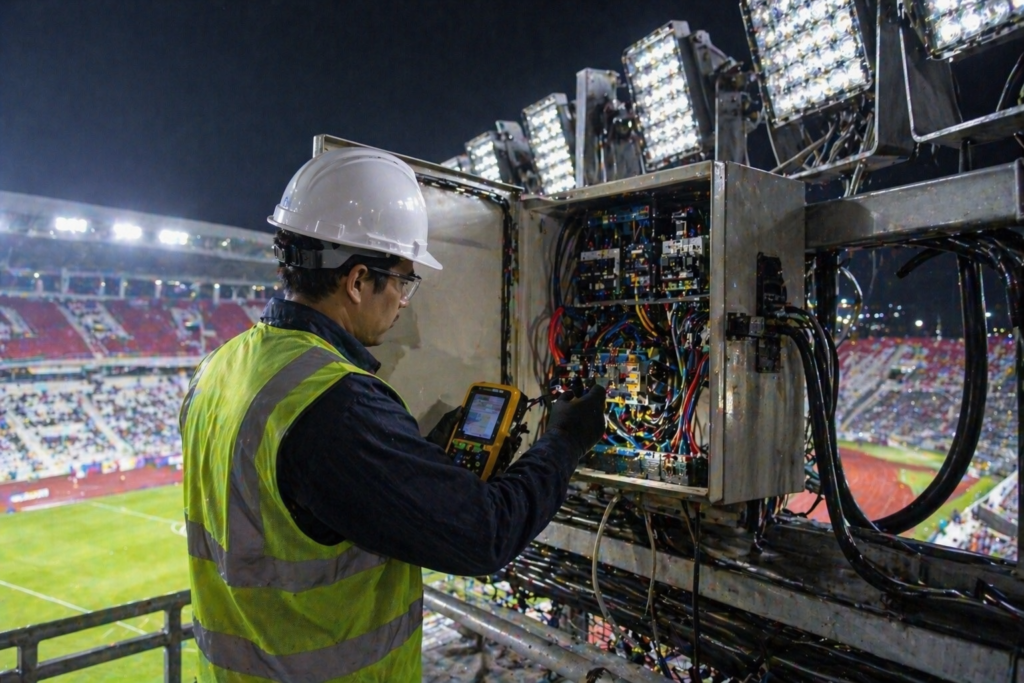
3.1 Environmental Exposure: Moisture, Dust, and Corrosion
The stadium lights location is almost in the outdoor location . While the former can penetrate into the equipment, leading to corrosion and internal damage, the latter decreases visibility and illumination capabilities over time.
3.2 Voltage Changes and Electrical Inconsistencies
Inconsistent electrical currents in the form of either spikes or low voltages can be extremely stressful for LED drivers as well as other electrical units, which typically leads to inefficient operation.
3.3 Physical Wear Because of the Wind and Vibration
Due to exposure to constant wind forces and vibrations, there is a risk of loosening mounting hardware and misalignment that influences the beam directionality.
4. Cleaning and Environmental Management
The formation of dust might seem to be a trivial process. In fact, it affects the light output in the long run, lowering the lighting quality. Moreover, it may cause the heating issues of lighting fixtures and thus affects their thermal management, contributing to faster wear of parts.
The importance of regular cleaning is hard to underestimate. This way, one can return lighting fixtures to normal functioning and prolong their service life. Special environmental factors have to be taken into account as well.
For example, coastal locations create an environment rich in salt particles, leading to corrosion. Industrial zones feature increased pollution in the form of particulates.
5. Thermal Management and Heat Dissipation
The heat that occurs in lighting is an invisible enemy that creeps up on the system slowly, often without being realized until the effects start to be noticed. A slight increase in temperature is enough to affect the performance and efficiency of the lighting system.
Thermal management is vital in ensuring that there is consistency within the lighting system by helping in dissipation of heat in the right way. Some of the tools required to achieve efficient dissipation include high conductive materials and ventilation paths.
High temperatures will have more effect on some of the delicate parts of the lighting system, such as the LED drivers. High temperatures will make these devices malfunction, causing inconsistencies in the functioning of the system.
6. Electrical System Optimization
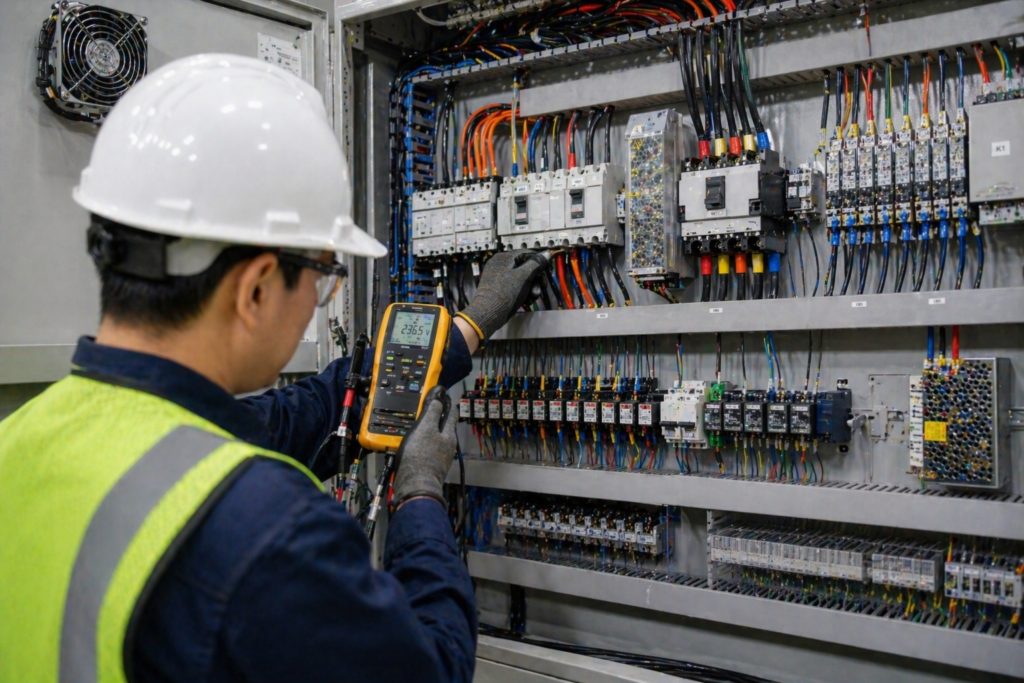
Electrical stability ensures consistent function of a light source system. Inconsistencies in the electrical supply could lead to inconsistent function, flicker, and even system failure. Small variations, when done repeatedly, will gradually affect the internal parts of the system.
Voltage regulation is another factor that guarantees consistent performance from the lighting system. Surge protection helps protect the electronic parts from being damaged by voltage surges. They are not added options; rather, they are crucial to ensure consistency of the lighting system.
Consistent wire quality is just as important as the rest of the wireing system to conntects the mainboard. Loose wiring increases the resistance level, causing the system to produce more heat, thereby reducing its efficiency. Finally, load balancing should be managed effectively to ensure proper power distribution.
7. Practical Solutions to Extend System Lifespan
Solving problems of maintenance demands a concrete action plan. It’s not just about the theory, but it’s all about the implementation of how to work and maintain proper structure. The process must be systematic for guaranteed reliability and to reduce legal problems. Maintenance of lighting fixtures needs to be scheduled according to the level of environmental exposure and to cause less damage. This will avoid unnecessary build-up of dust that could affect the effectiveness of lighting. Choosing the calibration of the light output is also necessary since it improves uniformity of lighting while minimizing the wear and tear of the lighting fixtures.
For high-exposure environments, there should be consideration of using non-corrosive materials for equipment parts to minimize their deterioration. Conducting regular thermal audits can also help monitor heat generation and improve ventilation. Inspection sheets help to make the process of maintenance systematic.
8. Technology-Driven Maintenance Solutions
Maintenance in modern times has become highly data-oriented like it all content to the cloud and server shifting from assumptions to accurate and measured results. This enables better performance analysis and timely decision-making by the operators.
Monitoring devices allow for continuous analysis of important elements like voltage, variations in readings, and consistency in output. In addition to this, predictive maintenance systems analyze the patterns and predict possible failures, thus avoiding downtime.
The use of automation has been proven to be highly effective since it allows for adjusting brightness and performance depending on the current usage environment. Besides being highly efficient, automation helps reduce stress on system components.
Controlled installation into centralized management systems helps in remote analysis of problems.
9. Maintenance Optimization Framework
| Maintenance Approach | Operational Efficiency | Cost Impact | Reliability Level | Intervention Frequency |
| Reactive Maintenance | Low | High | Unpredictable | Frequent |
| Scheduled Maintenance | Moderate | Controlled | Stable | Periodic |
| Predictive Maintenance | High | Optimized | Highly Reliable | Minimal |
| Smart Automated Systems | Very High | Long-term Saving | Consistent | Very Low |
10. Final Consultation and Strategic Recommendations
Maintaining a proper system is not a single event but a well-coordinated process that requires persistence, planning, and analysis for sustainability purposes.
It starts with an evaluation phase where you determine the present state of the system. This helps pinpoint the weak spots and other areas that may require urgent action. Afterward, a layered approach can be adopted, where routine inspection and predictive maintenance techniques are applied to strike the perfect balance between cost and efficiency.
Proper investments in human resources are equally important because eveting is not a automanted to work process; having trained professionals improves that maintenance is carried out. In addition, scalability remains crucial because maintenance needs should keep pace with the development of infrastructure.
FAQs
1. How often should stadium floodlights be maintained?
It all comes down to environmental impact and stress. Typically, monthly inspection of how the lighting is working and any issues in the system, while professional servicing is recommended once a year.
2. What are the most common causes of floodlight failure?
There are several reasons for the failures we have identified. Some of the reasons for this are dust, thermal stress, voltage instability, and part degradation. Environmental conditions also have their weighty contribution to the degradation.
3. Does regular cleaning really improve lighting efficiency?
Yes, it helps remove the contaminants that may reduce the efficacy, create heating problems, and hinder light emission.
4. How can electrical issues be prevented in floodlight systems?
Devices that protect against surges, regular wiring checks for any short circuits, and stability in power supply are the main ways of preventing electrical problems like high voltage.
5. Is preventive maintenance more cost-effective than reactive repairs?
Definitely yes, as unexpected malfunctions are expensive and require urgent repairs we have to react immideatly before it gets more dmage on the lights.